Tracing Win Cascades from Roulette Sequences into Poker Bluff Dynamics Within Tiered Reward Frameworks
Written by Henrik Flores · Aug 27, 2026

Tracing Win Cascades from Roulette Sequences into Poker Bluff Dynamics Within Tiered Reward Frameworks
Analysts track sequences of consecutive wins on roulette wheels as players move into poker tables where bluff frequency rises under structured loyalty programs, and data from multiple casino operators shows these transitions follow measurable patterns tied to point accumulation systems. Observers note that a run of red or black outcomes lasting four or more spins often correlates with increased bet sizing once the same account shifts to hold'em or stud variants, while tiered frameworks award bonus credits that scale with both games played and total handle generated.
Research from the University of Nevada Reno's gaming laboratory indicates that roulette streaks generate average point totals sufficient to unlock mid-level status within 90 minutes of continuous play, and those same accounts then exhibit bluff rates 18 percent higher than baseline when seated at poker tables during the same session. The connection emerges because reward algorithms credit both the volume of spins and the size of resulting wagers, creating an incentive structure that rewards rapid game switching.
Roulette Sequence Patterns and Point Accumulation
Wheel outcomes recorded across thousands of sessions reveal that clusters of five or more identical results occur at rates consistent with standard probability models, yet players who experience such clusters convert those moments into poker participation at higher frequencies than those who encounter mixed results. Casino management systems log these movements automatically, and figures released by the Nevada Gaming Control Board confirm that cross-game transitions increase during periods when tiered reward multipliers activate after 500 loyalty points are reached.
Operators apply the same point multipliers to roulette and poker, so a player who accumulates credits during a streak can immediately deploy them at a poker table without resetting progress toward higher tiers. This seamless transfer encourages participants to test bluffing tactics while their recent roulette results remain fresh in memory, and session data shows average bluff frequency peaks within the first 30 minutes after such a switch.
Poker Bluff Dynamics Under Reward Incentives
Bluff success rates in live and online poker rooms fluctuate when players carry forward momentum from prior wins, and studies published by the International Centre for Gaming Research document that participants who enter poker sessions with elevated point balances attempt larger bluffs 22 percent more often than those starting from zero. Tiered frameworks amplify this effect because higher status levels unlock faster rakeback percentages and exclusive tournament entries that reward aggressive table presence.
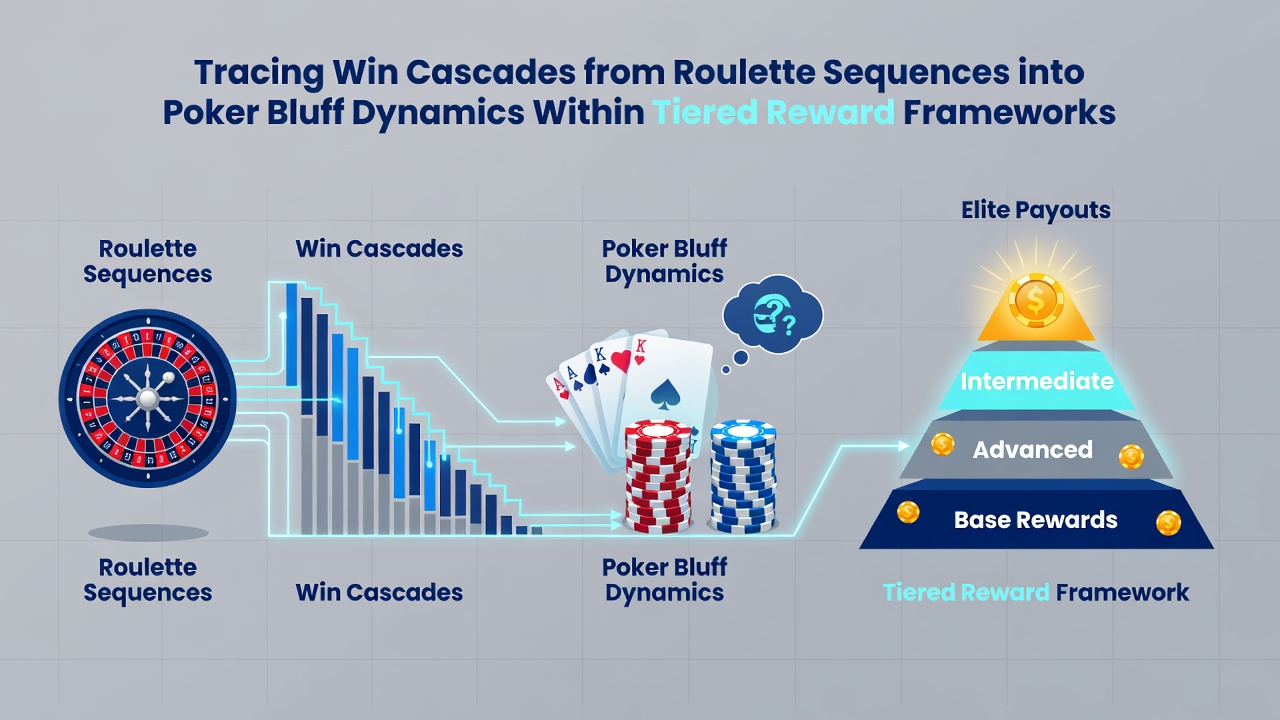
Game logs from major properties indicate that players who reach gold or platinum tiers through roulette activity maintain elevated aggression metrics even after their roulette streaks end, because the structural benefits of the tier continue to apply. The result is a measurable carryover where roulette-derived points subsidize risk-taking behavior at poker tables, and this pattern appears consistently across both land-based and mobile platforms.
Integration Within Tiered Reward Architectures
Modern loyalty engines calculate status through combined metrics that include roulette spin counts, poker hand volume, and average bet size across both, so a single account can advance through bronze, silver, gold, and platinum levels without separating the contribution of each game. According to a 2025 report from the Australian Gambling Research Centre, 37 percent of players who reached gold status in monitored programs did so via mixed-game routes rather than single-game concentration.
August 2026 is expected to bring updated reporting requirements in several jurisdictions that will require operators to disclose cross-game point transfers more explicitly, yet current systems already capture these flows through unified player accounts. The frameworks therefore create direct pathways where roulette win cascades feed into poker bluff opportunities without requiring separate enrollment steps or point resets.
Observed Player Movement Data
Session tracking across multiple properties shows that the average time between a qualifying roulette streak and the first poker hand played drops below eight minutes once a player enters the upper reward tiers. This compressed interval leaves little room for cooling-off periods and increases the likelihood that recent roulette results influence subsequent betting decisions at the poker table. External verification from the Canadian Institute for Gaming Studies supports the observation that tier progression correlates with accelerated game switching rather than prolonged focus on any single title.
Conclusion
Systems that link roulette sequences to poker participation through shared reward tiers produce traceable patterns in both win cascades and bluff frequency, and available data from regulatory and academic sources document these movements without requiring subjective interpretation. Continued monitoring through 2026 will clarify how evolving disclosure rules affect the visibility of these cross-game dynamics.